What You Can Build Without Planning Permission
Permitted development rights, explained for London homeowners in 2026 — and the limits that catch people out.
Not every extension needs a planning application. Under permitted development (PD) rights, many London homeowners can extend, convert a loft, or add an outbuilding without ever going to the planning committee — saving months and removing a major source of uncertainty. But PD is narrower and more conditional than most people assume, and getting it wrong can mean an enforcement notice and undoing the work.
Here is where the lines sit in 2026 — written for England's householder PD rules. Always confirm the detail for your own property, because the conditions vary by house type, by location, and by whether your council has removed PD rights in your area.
What permitted development actually is
PD rights are a national grant of planning permission from central government, so you can build certain things without applying to your local council. They apply to houses, not flats or maisonettes (which have no PD rights at all), and they carry strict conditions on size, height, position and materials. Break any single condition and the whole project falls outside PD — needing a full householder planning application instead.
Permitted development limits at a glance
Here is how the main allowances compare by project and house type (England, 2026). Treat these as the standard limits — your specific property, and any Article 4 direction, can change them.
| Project | Terraced / Semi | Detached | Max height |
|---|---|---|---|
| Single-storey rear extension | 3m deep (up to 8m with prior approval) | 4m deep (up to 8m) | 4m |
| Side extension | Max ½ the width of the house | Max ½ the width | 4m |
| Rear dormer loft | Up to 40m³ added volume | Up to 50m³ | Below the ridge line |
| Outbuilding (garden room) | Max 50% garden coverage | Max 50% garden coverage | 2.5m near a boundary |
Want a real number instead of a range?
Get a fixed-price quote for your extension
We visit, measure and send an itemised quote on a JCT contract. Every job carries our 10-year workmanship warranty.
Book a site visit WhatsApp us your postcodeCHAS Elite · Constructionline Gold · FMB member · 5.0 on Google
Single-storey rear extensions
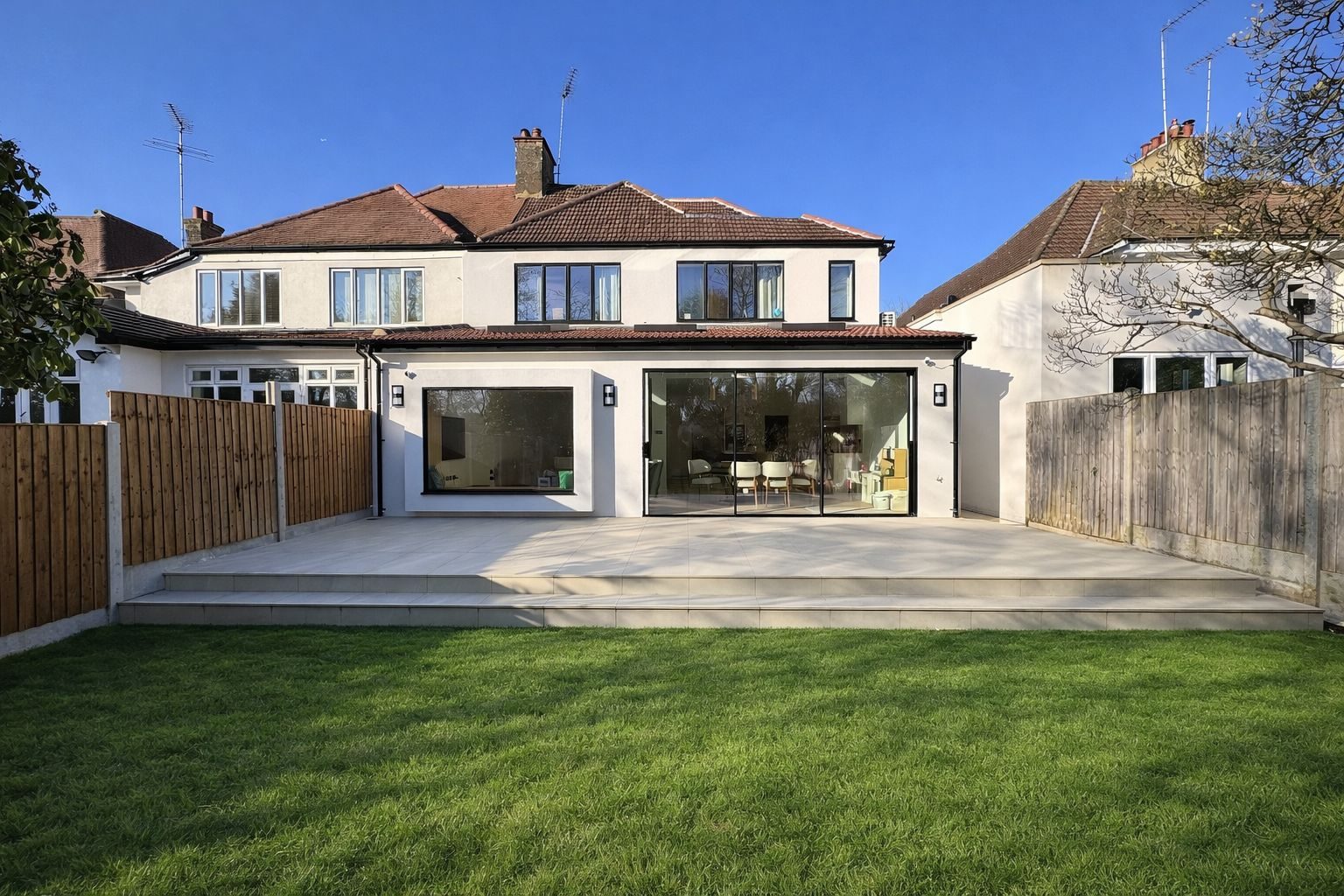
This is the most common PD project. You can build a single-storey rear extension up to:
- 3m deep for a terraced or semi-detached house, or 4m for a detached house, with a maximum height of 4m.
- 6m / 8m respectively under the Larger Home Extension route — now a permanent scheme — which needs a prior-approval neighbour-consultation process (adjoining neighbours are notified and can object).
If the extension comes within 2m of a boundary, the eaves cannot exceed 3m, and materials should be similar in appearance to the existing house.
Loft conversions and dormers
A rear dormer usually sits within PD, provided the added roof volume stays under 40m³ (terraced) or 50m³ (semi-detached and detached). The catch most people miss: you cannot add a dormer to the principal (front) elevation facing a road under PD, side-facing windows must be obscure-glazed and non-opening below 1.7m, and the dormer must be set back from the eaves. Mansard conversions almost always need full planning permission.
Side extensions and outbuildings
- Side extensions: single storey only, maximum 4m high, and no wider than half the width of the original house.
- Outbuildings (garden offices, gyms): single storey, maximum 2.5m high within 2m of a boundary, not forward of the front elevation, and covering no more than 50% of the garden.
When permitted development does NOT apply
- Flats and maisonettes — no PD rights whatsoever.
- Conservation areas, listed buildings and AONBs — heavily restricted; listed buildings need consent for almost any change.
- Article 4 areas — your council can remove PD rights street by street (common across London's conservation areas). Always check your specific address.
- Anything forward of the principal elevation, or beyond the size limits above.
A builder's reality check: PD rules read simply but trip people up constantly — boundary distances, Article 4 directions, and roof-volume maths are where projects unravel. Before you commit, get the property properly assessed. At Alstruct we confirm exactly what is achievable under permitted development for your specific home as part of our design stage, and handle the certificate or the planning route either way — so you start with certainty, not a gamble.
The smart move: a Lawful Development Certificate
Even when your project clearly is permitted, it is worth applying for a Lawful Development Certificate (LDC) from the council. It is a formal confirmation that no planning permission is needed — invaluable when you come to sell, and protection against any future dispute. It is faster and cheaper than a full planning application, and it removes the risk of an enforcement issue later.
Common permitted development mistakes
The same handful of errors trip homeowners up again and again — and they are expensive to undo:
- Assuming PD applies in a conservation area. Many rights are removed or reduced; side extensions and cladding almost always need permission.
- Forgetting about Article 4. Councils can strip out PD rights street by street — your neighbour's project being fine doesn't mean yours is.
- Miscalculating depth or roof volume. A few centimetres over the 3m/4m line, or over the 40m³/50m³ loft volume, takes the whole project outside PD.
- Skipping the Lawful Development Certificate. Without it you have nothing to prove the work was lawful when you sell.
- Treating a flat like a house. Flats and maisonettes have no PD rights at all — every change needs an application.
Frequently Asked Questions
Can I build an extension without planning permission in London?
Often yes. Single-storey rear extensions up to 3m (terraced/semi) or 4m (detached), side extensions, and rear dormer loft conversions frequently fall under permitted development. It depends on your property type, the size limits, and whether you are in a conservation area or an Article 4 zone where these rights are removed.
Do flats have permitted development rights?
No. Permitted development rights apply to houses only. Flats and maisonettes have no PD rights, so any alteration requires a planning application.
Does permitted development apply in conservation areas?
It is heavily restricted. Many permitted development rights are removed or reduced in conservation areas, and side extensions, cladding and roof alterations usually need planning permission. Always check your specific address, as Article 4 directions can remove PD rights street by street.
What happens if I build outside permitted development by mistake?
The council can issue an enforcement notice requiring you to alter or remove the work. Applying for a Lawful Development Certificate before you start formally confirms the work is permitted and removes that risk.
Want a real number instead of a range?
Get a fixed-price quote for your extension
We visit, measure and send an itemised quote on a JCT contract. Every job carries our 10-year workmanship warranty.
Book a site visit WhatsApp us your postcodeCHAS Elite · Constructionline Gold · FMB member · 5.0 on Google